Seven years into homeschooling, I can tell you exactly which curriculum we used for third grade math. I can also tell you I don’t remember most of it teaching my kids the way one week away from home did.
There’s a word for what we’ve been doing without ever really naming it — worldschooling. It sounds like a whole movement with a manifesto and a hashtag, and for some families it is. For us, it was simpler than that. It was just letting the trip be part of the lesson instead of a break from it.
What Worldschooling Actually Means (It’s Less Complicated Than It Sounds)
If you’ve never heard the term, worldschooling is basically what it sounds like — using real travel and real-world experience as part of your kids’ education, instead of treating school and travel as two separate things that compete for time. It’s not a curriculum. It’s not a certification. It’s a mindset shift, and honestly, most homeschool families are already doing pieces of it without calling it anything.
We’ve used Classical Conversations as our core homeschooling curriculum for most of these seven years, and I want to be clear — this isn’t a “throw out the books” philosophy. The curriculum still matters. What changed for us is realizing that a week in a different country, on a ship, or standing somewhere our kids had only read about in a textbook, wasn’t time away from learning. It was learning, just from a different desk. And if you’re a CC family reading this — you already know that community is half the magic of this whole homeschooling life. It’s funny how often that same community shows up when we’re helping families plan trips too. Something about CC families and travel just seems to go together. Maybe it’s the curiosity. Maybe it’s just that we’re all a little bit wired the same way.
The Lesson That Stuck Longer Than Any Worksheet
We took a trip to the Riviera Maya in Mexico, and I still think about how much my kids absorbed in that one week that no unit study could have handed them the same way.
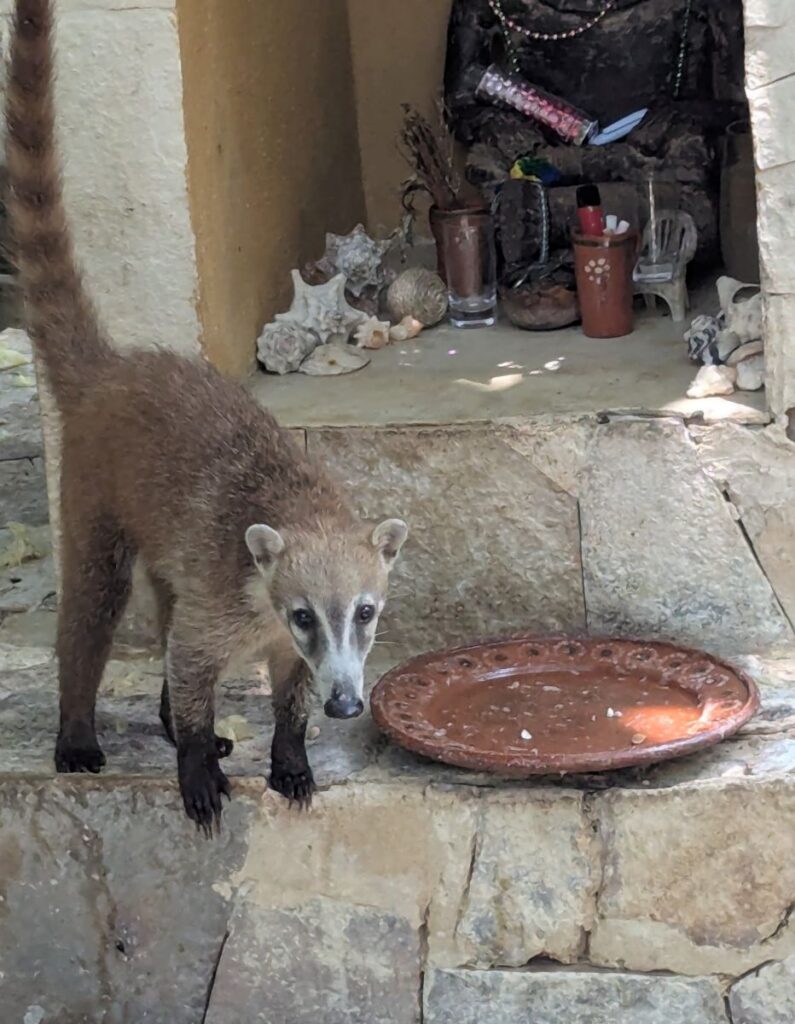
Coati wildlife encounter Riviera Maya
We were out one day and came across coatis — these raccoon-looking creatures with long striped tails that you simply do not see in the U.S. My kids stood there watching them, completely fascinated, asking question after question about what they ate, where they lived, why they looked the way they did. No worksheet was going to spark that kind of genuine curiosity. Seeing the actual animal did.
They also got to practice their Spanish in real situations — ordering food, saying thank you, trying to figure out directions — and there’s a difference between conjugating verbs on a page and needing the language to actually work for you in the moment. I watched their confidence build in real time.
Then there were the churches. We walked into buildings that were standing before the 19th century, and my kids just stopped. Stood there taking it in. We’d talked about history, about how old some of these places in the world really are, but there’s something that happens when a kid is physically standing inside something that old. It becomes real instead of abstract.
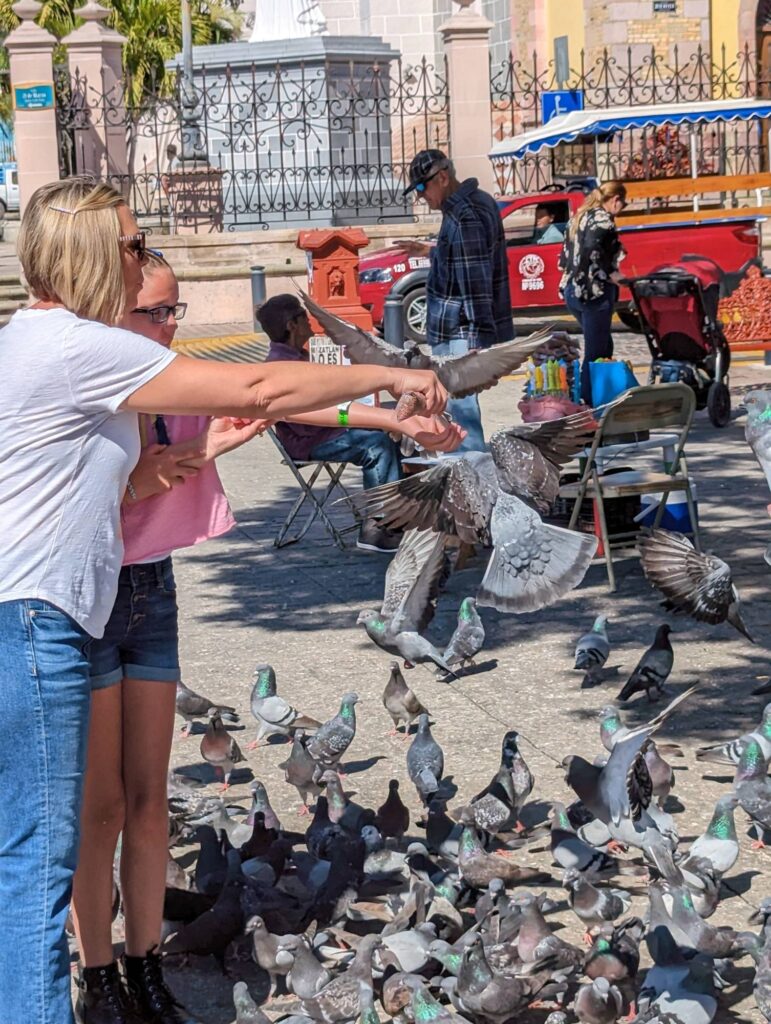
But if you asked my kids what they remember most from that trip, I’d bet they’d say the birds. We found a park/plaza where you could hold birdseed in your open hand, and the birds would actually land right on your arm and eat out of your palm. My kids stood there, arms out, absolutely lit up, for as long as we’d let them. It wasn’t a lesson about anything in particular. It was just wonder. And I think that’s part of worldschooling too — not everything has to tie back to a subject. Sometimes the world just gets to amaze them, and that’s enough.
That’s the thing nobody tells you about traveling with homeschooled kids. You don’t have to choose between the trip and the school day. The trip becomes the school day, if you let it.
What My Kids Actually Learned That Wasn’t on Any Syllabus
Some of the most important things my son and daughter picked up over the years didn’t come from a textbook at all:
- How to talk to adults who aren’t family — waiters, tour guides, cabin stewards, other travelers — with actual eye contact and actual manners
- How to problem-solve in real time when a flight got delayed or plans changed, instead of falling apart
- How to be flexible when the day didn’t go the way it was supposed to
- How to notice things — a different language, a different way of eating dinner, a different pace of life — without judging it, just noticing it
- How much bigger and more varied the world is than four walls and a curriculum can fully capture, no matter how good the curriculum is
Situational Awareness — The Lesson We Never Skip
Here’s one we work into every single trip, without exception, and honestly, into everyday life at home too: situational awareness.
We want our kids to be kind. We want them to be polite, to greet people warmly, to say yes to new experiences. But we’ve also worked hard to teach them the difference between being courteous and ignoring an actual safety concern — because those are not the same thing, and kids need to be taught that distinction on purpose. It doesn’t happen automatically.
Practically, that’s looked like things such as:
- Knowing it’s okay to say no to an adult, even a friendly one, if something feels off — politeness never outranks their own safety
- Staying aware of exits, of where we are in a crowd, of who’s around them, whether we’re in a foreign port or in our own neighborhood back home
- Understanding that being nice to someone and trusting someone are two different decisions
- Knowing our meeting point plan the moment we arrive anywhere new — a ship, a resort, a busy market — before anything else happens
- Trusting their gut, and knowing that telling us “something feels weird” is always the right call, never an overreaction
This isn’t about raising anxious kids who see danger everywhere. It’s the opposite, actually. Kids who understand real situational awareness tend to move through the world with more confidence, not less, because they’re not operating on either blind trust or blind fear. They’re operating on good judgment. And that’s a skill that travel gives you more chances to practice, in more real situations, than almost anything else we do at home.
You Don’t Need a Passport Stamp for Every Country to Make This Work
Here’s where I’ll gently push back on the version of worldschooling that shows up on social media — the families living out of backpacks in a new country every month. That’s not most of us, and it doesn’t need to be for this to work.
Homeschool field trips count. A weekend trip a few hours from home counts. A single cruise counts, and honestly, might be one of the easiest ways to do this well, since a ship moves you through multiple ports and cultures in a single week without you having to plan a single logistic beyond the one big one. We’ve found that the containment of a cruise — everyone under one roof, meals figured out, a plan already built — actually makes it easier to focus on the learning happening at each stop, instead of spending all our energy on logistics like you would backpacking somewhere entirely on your own.
How We Actually Fold Learning Into a Trip (Without Turning Vacation Into School)
We don’t pack workbooks on vacation. That’s not what this is. What we do instead is simpler:
- Talk about where we’re going before we go — a little history, a little geography, enough that it’s not a blank spot on a map anymore
- Let questions come up naturally once we’re there, and actually answer them instead of saying “we’ll look it up later”
- Point out connections to things we’ve already studied — a battle we read about, a language family we learned the roots of, a food we’ve talked about in a unit study
- Let the kids keep a simple journal, even a few lines a day, of what they saw and what surprised them
None of this requires a special curriculum add-on or a “travel unit” you have to buy. It requires being willing to let the trip do some of the teaching.
A Few Honest Answers to Questions I Get Asked a Lot
Is worldschooling legal if I’m already homeschooling?
Yes — if you’re legally homeschooling under your state’s requirements, incorporating travel into that education doesn’t change your legal standing. You’re still homeschooling; you’re just choosing where some of the learning happens. Nevada’s homeschool requirements are the same whether your classroom is your kitchen table or a ship’s library.
Do I need a special curriculum for worldschooling?
No. Most families, us included, keep their core curriculum and simply layer real-world experience on top of it rather than replacing it. The trip enriches the lesson; it doesn’t need to become the whole lesson plan.
What age is best to start traveling with homeschooled kids?
Honestly, any age. We started young and have kept going as our kids became teenagers, and the lessons just get deeper and more meaningful as they get older and can engage with more of what they’re seeing.
The Real Reason We Keep Doing This
If you’d asked me seven years ago whether travel would end up being one of the most valuable parts of our homeschool journey, I’m not sure I would have believed you. I thought the curriculum was the education and the trips were the reward for finishing it.
Now I think about it the other way around. The curriculum gave my kids the foundation. The trips are where a lot of it actually became real to them — coatis in the jungle, Spanish that finally worked in real conversation, churches older than our whole country, a handful of birds willing to land on two kids’ outstretched arms, and a habit of paying attention to the world around them that I hope stays with them long after they’ve left our house.
If you’re a homeschool family in Northern Nevada — or anywhere — trying to figure out how to make travel part of your kids’ education instead of a break from it, I promise it’s simpler than it looks from the outside. You don’t need a plan for a year abroad. You need one trip you’re willing to let teach alongside you.
And if the travel-planning part of it feels like the harder piece to figure out than the homeschooling part — that’s where my husband Anthony and I come in. He’s the one who handles the logistics side of our family’s trips, and it’s also what he does for other families every day. If you’d rather have a real person help you build a trip that actually works for your family’s schedule and budget than piece it together yourself, that’s exactly what he does.


Erin Howard
